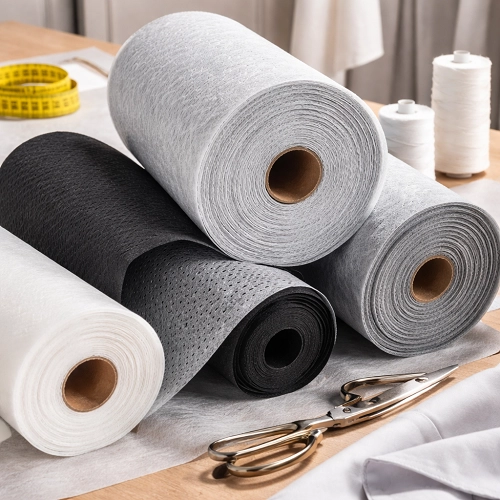
Non-woven interlining is a foundational component in the modern textile and apparel industry—playing a critical role in shaping, supporting, and enhancing the appearance and performance of garments and textile products. Unlike woven or knitted interlinings, non-woven interlinings are manufactured by bonding fibers together through mechanical, chemical, or thermal processes, resulting in versatile, engineered fabrics that meet a wide range of technical requirements.
What Is Interlining? Functional Purpose
Interlining refers to a secondary fabric layer placed between the outer fabric and the garment’s facing or lining.
Its primary functions include:
- Support & Structure: Reinforcing areas such as collars, cuffs, front facings, waistbands, and plackets.
- Shape Retention: Helping garments hold intended silhouettes over repeated use.
- Comfort & Fit Enhancement: Smoothing seams and improving drape while reducing irritation.
- Performance Improvement: Adding thermal insulation, stability, or stretch control where needed.
Non-woven interlining is a class of interlining where the fabric isn’t formed by traditional weaving or knitting but by bonding fibers into a cohesive sheet. This process defines its unique properties.
Non-Woven Manufacturing Techniques
Non-woven interlining production is not uniform; different bonding techniques yield materials with distinct attributes.
Mechanical Bonding
- Needle Punching: Barbed needles repeatedly penetrate a fiber web, entangling the fibers. This increases strength and thickness.
- Hydroentanglement (Spunlace): High-pressure water jets entangle fibers, creating a soft and flexible fabric.
Thermal Bonding
Heat is applied to melt synthetic fibers or thermoplastic binders within the fiber web. When cooled, fibers fuse at contact points.
- Produces firm, stable interlinings.
- Commonly used with fibers like polyester or bicomponent fibers.
Chemical Bonding
Adhesive resins or binders are sprayed/impregnated into a fiber web to bond fibers together.
- Allows precise control of stiffness and flexibility.
- Requires careful consideration of residue, hand feel, and environmental impact.
Materials Used in Non-Woven Interlinings
The choice of fiber and binder dramatically influences performance:
Natural Fibers
- Cotton: Breathable and comfortable; often used for lightweight garments.
- Wool: Provides warmth and resilience; used in tailored coats and jackets.
Synthetic Fibers
- Polyester: High strength, dimensional stability, and low cost; very common.
- Polyamide (Nylon): High abrasion resistance; less used due to moisture issues.
- Polypropylene: Lightweight and chemical-resistant; mostly for disposable or industrial applications.
Bicomponent Fibers
Fibers with two polymers (e.g., core-sheath polyester) that allow thermal bonding without additional adhesives.
Blends and Specialty Fibers
Blends (e.g., cotton-polyester) combine properties such as comfort with stability. Specialty fibers such as flame-retardant or conductive fibers tailor interlinings to niche needs.
Types and Characteristics of Non-Woven Interlinings
Fusible vs. Sew-In
- Fusible Non-Woven: Coated with a heat-activated adhesive on one or both sides. When pressed with heat and pressure, it bonds to the fashion fabric.
- Sew-In Non-Woven: No adhesive; secured through stitching. Offers flexibility for delicate fabrics that cannot tolerate heat.
By Hand and Performance
- Soft: Minimal body; used for lightweight garments like shirts and dresses.
- Medium: Balanced support; suitable for blazers and skirts.
- Firm: Maximum structure; ideal for tailored jackets, waistbands, and suits.
Specialty Functional Interlinings
- Elastic Interlinings: Provide stretch and recovery.
- High-Temperature Resistant: Used in industrial or protective clothing.
- Moisture-Management: Integrated wicking or breathable features.
Key Performance Properties
Different performance metrics determine the suitability of a non-woven interlining for a particular application:
Tensile and Tear Strength
Reflects durability under stress. Critical for areas like waistbands and collars.
Flexibility and Drapability
Assesses how well the interlining moves with the garment, affecting comfort and appearance.
Adhesion Strength (for Fusibles)
Evidence of how strongly the interlining bonds to the fashion fabric after fusing.
Dimensional Stability
The ability to resist shrinkage, stretch, or distortion during laundering or wear.
Thermal Performance
For interlinings in outerwear or protective garments.
Hand Feel
The tactile quality—softness or stiffness—affects wearer comfort and garment aesthetics.
Testing Standards and Quality Control
Manufacturers rely on standardized test methods to assess interlining performance, many of which originate in:
- ASTM International
- ISO (International Organization for Standardization)
- AATCC (American Association of Textile Chemists and Colorists)
Examples include:
- Tensile and Elongation Tests
- Bond Strength Testing (Peel/Shear for fusibles)
- Dimensional Change (Shrinkage)
- Heat Resistance and Melt Testing
Quality assessment also involves visual inspection, thickness measurement, and hand evaluation.
Applications Across Industries
Though most prominent in apparel, non-woven interlinings serve multiple markets:
Apparel and Fashion
- Tailored Suits & Jackets: Provide structure and silhouette control.
- Shirts & Blouses: Fusible interlinings ensure crisp collars and cuff stability.
- Dresses & Skirts: Medium-weight interlinings manage waistbands and facings.
- Children’s Wear: Soft, comfortable interlinings that maintain modest structure.
Footwear and Accessories
Used in hats, belts, bags, and even in footwear components for support and shape.
Home Textiles
Curtains, slipcovers, and upholstery benefit from non-woven interlinings for reinforcement and durability.
Industrial and Technical Textiles
Non-woven interlinings with specialized fibers find use in filtration, automotive interiors, medical textiles, and protective clothing.
Sustainability Considerations
Environmental performance is increasingly central:
Recycled Fibers
Use of recycled polyester reduces reliance on virgin plastics.
Biodegradable/Bio-based Options
Research into natural fiber blends and bio-based polymers aims to minimize environmental impact.
Reduced Chemical Use
Thermal or mechanical bonds may replace chemical binders to lower toxicity and improve recyclability.
Circularity and End-of-Life
Design for disassembly supports garment recycling—especially where separable non-woven interlinings simplify material recovery.
Application Best Practices and Selection Guide
When choosing a non-woven interlining, consider:
| Criteria |
Questions to Ask |
| Fabric Type |
Is the fashion fabric delicate (silk) or robust (denim)? |
| Desired Structure |
Light, medium, or firm support needed? |
| Fusible vs. Sew-In |
Can fabric tolerate heat? |
| Wear & Care |
How often will the garment be laundered? |
| End Use |
Casual, formal, protective, or technical application? |
Manufacturers often supply technical data sheets with recommended pressing temperatures, adhesion guidelines, and compatibility charts.
Future Trends and Innovations
- Smart Interlinings: Embedded sensors or conductive fibers for wearable technology.
- Nanofiber Reinforcements: Enhanced performance at minimal weight.
- Eco-Certified Materials: Growth in demand for certifications (OEKO-TEX, GRS).
- Custom Engineered Solutions: Engineered interlinings tailored to specific end-use demands through advanced bonding technologies.
Non-woven interlining is more than a hidden garment component—it is a sophisticated engineered textile that shapes performance, comfort, and quality across a broad spectrum of products. Understanding the materials, manufacturing processes, functional properties, and design considerations helps textile professionals and fashion designers make informed decisions that elevate both product performance and sustainability.